
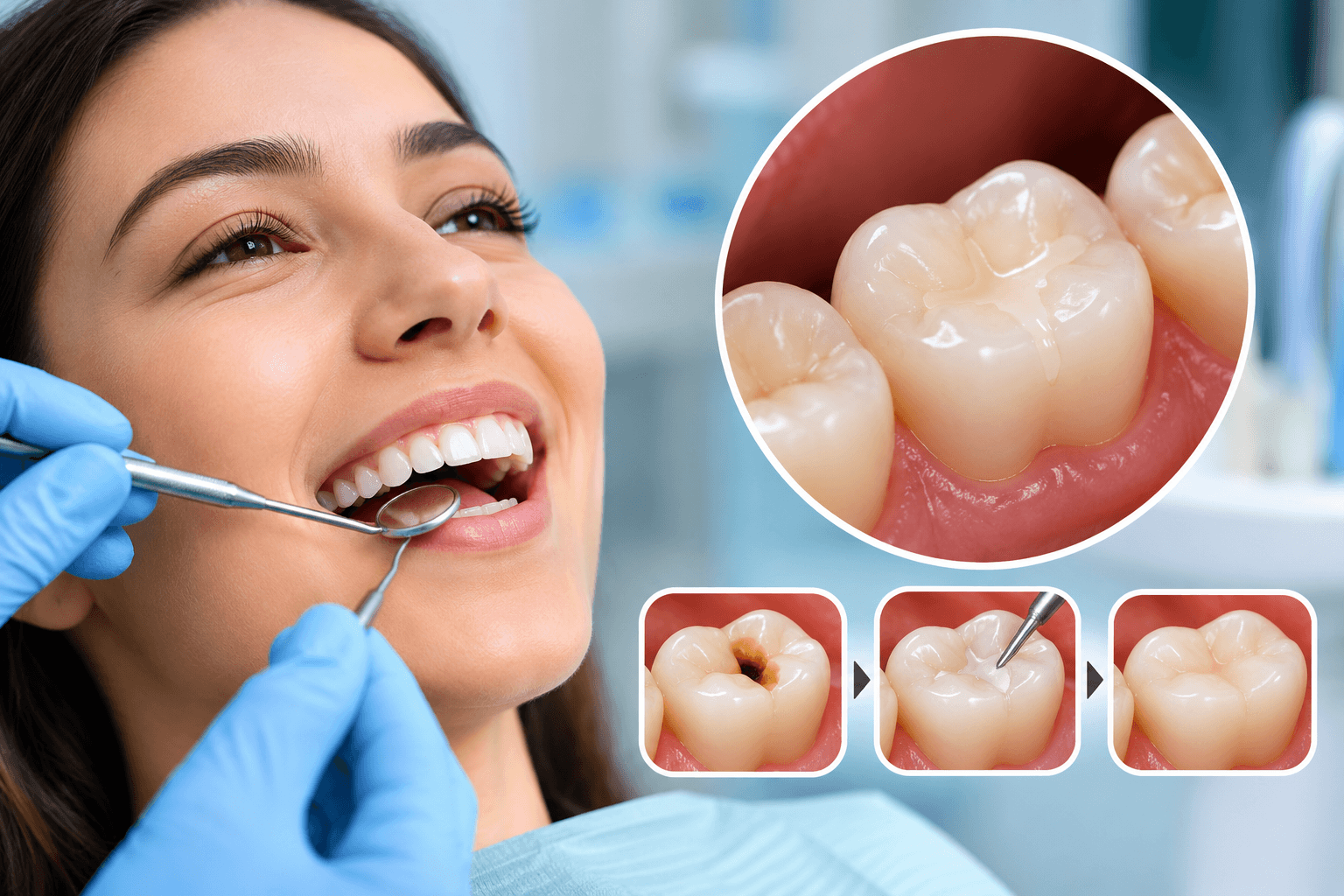
A composite tooth filling is a tooth-colored restoration made from a blend of plastic resin and fine glass particles, used to repair cavities, chips, cracks, and worn enamel. Unlike silver amalgam fillings, composite bonds chemically to the tooth structure and is shaded to match your natural enamel, making it nearly invisible. Most composite fillings are placed in a single visit of roughly 30 to 60 minutes.
What a Composite Filling Actually Involves
Composite resin is not one material but a family of formulations that have improved significantly over the past two decades. Modern composites use nano-hybrid or micro-hybrid filler particles, which give the material better wear resistance and polishability than earlier generations. That matters because a filling in a back molar has to survive chewing forces that a front-tooth filling never experiences.
The defining advantage is conservative preparation. Because composite bonds adhesively rather than relying on mechanical retention, the dentist removes less healthy tooth structure than with amalgam. The cavity prep only needs to eliminate decay and create a clean bonding surface, not undercut the tooth to lock material in.
| Factor | Composite Filling | Amalgam Filling |
| Appearance | Matches tooth shade | Silver-gray, darkens over time |
| Tooth removal | Minimal, bonds to enamel and dentin | Requires undercuts for retention |
| Placement time | Typically 30 to 60 minutes | Similar or slightly faster |
| Typical lifespan | Around 5 to 10 years, sometimes longer | Often 10 to 15 years |
| Sensitivity to moisture | High during placement, requires isolation | Low |
The Procedure Step by Step
The process follows a predictable sequence, but the details matter more than patients often realize.
First, the dentist numbs the area with local anesthetic. This is not always strictly necessary for very small fillings, but most dentists use it to keep the patient comfortable and to work precisely without flinching.
Next, decay is removed and the cavity is shaped. The tooth is then isolated, usually with a dental dam or cotton rolls, because composite will not bond properly to a wet surface. This is the step that separates good composite work from mediocre work: any contamination from saliva or blood weakens the bond and shortens the filling’s life.
A mild etching gel prepares the enamel and dentin, followed by a liquid bonding agent. The composite is then applied in thin increments, each layer hardened with a curing light. Layering prevents shrinkage stress and allows the dentist to build up natural tooth contours. Finally, the filling is shaped, adjusted to your bite, and polished.
How Long Composite Fillings Last
The commonly cited range is 5 to 10 years, but that is a broad average, not a guarantee. Several factors move the real number up or down. Small fillings in low-stress areas can last well beyond a decade. Large fillings that replace a cusp or cover most of the chewing surface tend to fail sooner because the remaining tooth flexes under load.
Oral hygiene is the biggest patient-controlled variable. Composite margins are more prone to recurrent decay than amalgam margins, so brushing, flossing, and regular checkups matter more. Bruxism, or teeth grinding, also shortens lifespan, as does a diet heavy in acidic drinks. The honest answer is that composite fillings do not last a lifetime, and no filling material does. They are a repairable, replaceable restoration.
Cost Factors Without the Numbers
Pricing varies too much by region and clinic to quote meaningfully, but the qualitative factors are consistent. Composite fillings typically cost more than amalgam because they take longer to place and the material is more technique-sensitive. The size and location of the cavity, the number of surfaces involved, and whether the tooth is a front tooth or a molar all influence the final fee. Clinics with digital caries detection, such as those offering comprehensive Services in Dubai, may catch decay earlier, which can mean smaller and less expensive fillings. Patients looking for a Cheap Dentist in Dubai or a Cheap Dental Clinic Deira should weigh the material quality and the dentist’s experience, not just the listed fee, since a poorly bonded composite fails early and costs more over time.
Common Mistakes and Practical Tips
Patients sometimes assume a composite filling means the tooth is as strong as an unfilled tooth. It is not. The restoration replaces lost structure but does not reinforce the remaining enamel the way a crown does. For large cavities, a dentist may recommend an onlay or a crown instead, and that recommendation is usually the right one.
Another common issue is post-placement sensitivity. Some sensitivity to cold is normal for a few days, especially on deeper fillings. Persistent sharp pain when biting usually means the filling is too high and needs a quick adjustment. Dull, lingering pain may indicate the nerve is inflamed, which requires evaluation.
If you are near Dubai Creek or the older commercial districts, finding a Best Dentist in Deira, Dubai is not difficult, but look for one who explains the moisture-control protocol and offers a warranty on the work. Practices that also provide Dental crowns in dubai and Dental Crowns & Bridges in Deira are often equipped to handle the full spectrum, from small fillings to major rebuilds, which matters if your cavity turns out larger than expected. The Best Dental Clinic in Deira Dubai will usually show you the shade match before starting and check your bite carefully before you leave.
FAQ
Is composite bonding safe during pregnancy?
Composite fillings are generally considered safe during pregnancy, particularly for treating active decay that could otherwise lead to infection. The materials are locally applied and do not enter the bloodstream in meaningful amounts. Many dentists prefer to defer elective cosmetic bonding until after delivery but will treat necessary cavities, ideally during the second trimester. Always inform your dentist so they can coordinate with your obstetrician if needed.
Do composite fillings last a lifetime?
No. Composite fillings typically last around 5 to 10 years, though small ones can last longer with excellent hygiene. They wear, stain at the margins, and can develop recurrent decay. Regular dental exams allow early detection of failing margins before the tooth underneath is damaged.
How much does dental pasta cost?
Dental pasta, often called composite resin or filling paste, is the material dentists use to place tooth-colored fillings. Its cost is bundled into the total filling fee rather than sold separately. The final price depends on cavity size, number of surfaces, and the clinic’s location and expertise.
How much should a resin composite filling cost?
Costs vary widely by country, city, and the complexity of the case. A single-surface filling costs less than a multi-surface molar restoration. Rather than focusing on a specific number, compare what is included: the quality of the composite material, moisture isolation technique, bite adjustment, and any follow-up care.
If you have a cavity, chip, or an old silver filling you want replaced, the next step is a clinical exam and an honest conversation about whether composite is the right material for that specific tooth. Book an appointment with a dentist who will show you the shade, explain the isolation protocol, and check your bite before you leave the chair.