Is a Crown Necessary After Root Canal Treatment,Whilst in some cases a crown may be required following root canal therapy, this largely depends upon which tooth has been treated and the extent of remaining original tooth structure. Usually, back teeth (particularly molars) require crowns due to the high biting pressure that they endure. Often, front teeth can be left without a crown if the tooth has not been badly affected and an adequately filled. Here at Calcium Clinic, each treated tooth is analysed to determine what course of action is most suitable.
When the Tooth Actually Needs Full Coverage
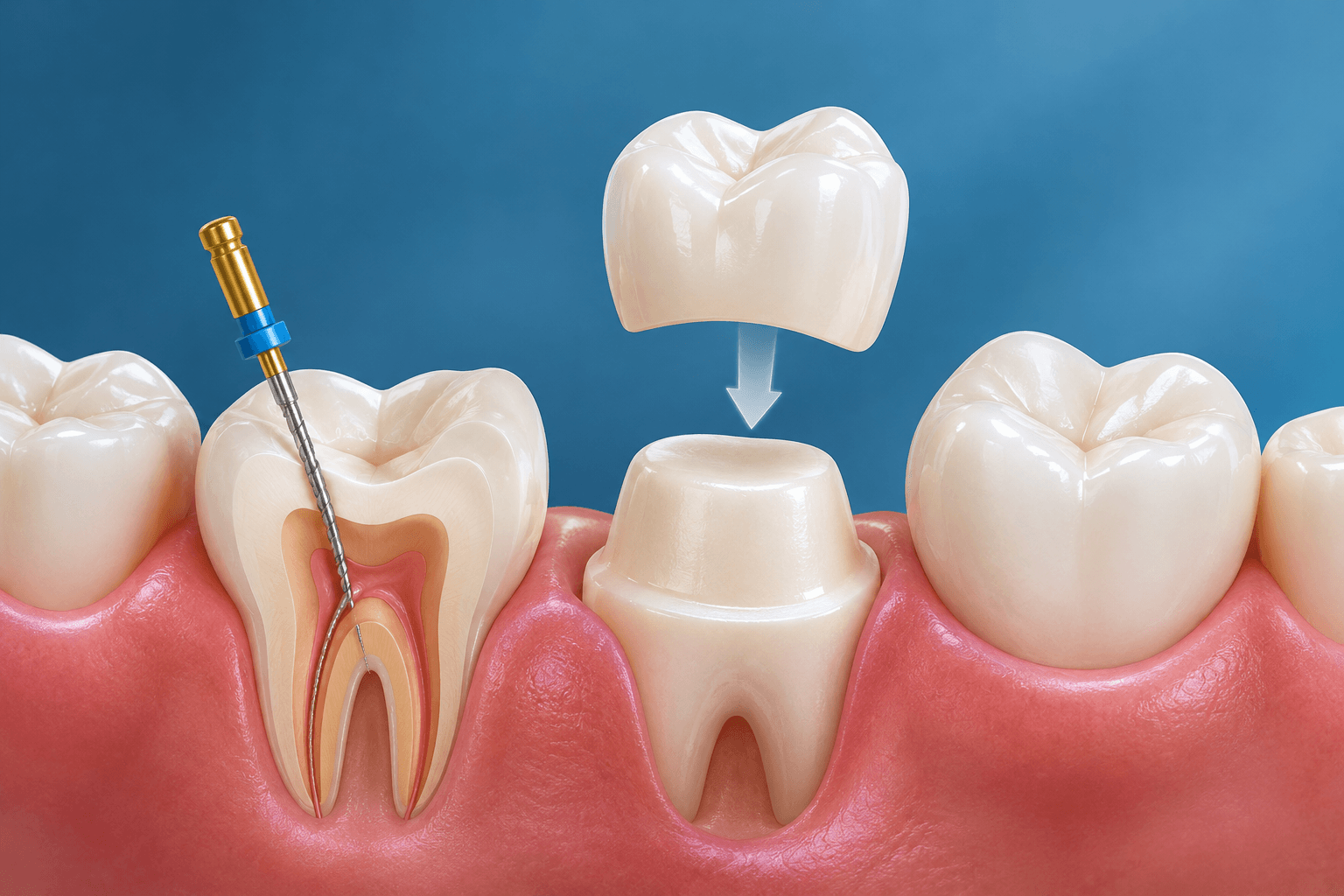
Following a root canal treatment, the pulp (which contains the tooth’s blood supply) is removed. The tooth thus becomes more fragile and is consequently more susceptible to damage. A crown is then fitted to encase the tooth. It both reinforces the tooth and allows occlusal forces to be shared out.
Molars and premolars are usually the best candidates for crowns. As these teeth are heavily involved in the mastication process, if a person breaks a posterior tooth they are often advised to have it removed. Furthermore, teeth which had previously suffered from extensive fillings, considerable decay and/or fractures are not ideal for just having a filling fitted following a root canal. Extra tooth substance is also lost through the hole made to allow the dentist to perform the root canal. Consequently, the tooth may become structurally unsound.
Finally, bruxism can also affect suitability for a crown. Patients who habitually clench or grind their teeth exert immense side-way forces upon their teeth. For such people, a crown is often no longer just a sensible option, but actually becomes essential.
When a Filling May Be Enough
Incisors and canines are used for less forceful biting. Provided that the root canal has been accessed via a small hole and the tooth still has a good amount of its natural outer layer (enamel), a robust composite filling can often be used and will offer a suitable restoration. This tends to be the case if the initial issue was related to trauma and not significant tooth decay.
Certain premolars can also be treated in this ‘in between’ way. The dentist may suggest an onlay which will restore both the occlusal plane and one or more cusps but does not completely surround the tooth. This again allows more of the natural tooth to remain but also adds extra support to the weakened sections.
How Dentists Make the Call
| Factor | Favors Crown | Favors Filling |
| Tooth location | Molar or premolar | Incisor or canine |
| Remaining tooth walls | Thin, few intact walls | Thick, mostly intact |
| Previous restorations | Large existing fillings | Minimal or none |
| Bite forces | Heavy chewing, grinding | Light, normal function |
| Cosmetic needs | Discolored or misshapen | Acceptable appearance |
Timing is also an important factor. Whilst a provisional crown can be fitted at the end of a root canal to provide immediate protection, a patient should ideally have their definitive crown fitted within a few weeks. After this period, the risk of a tooth breaking is heightened particularly for molars. Should a patient’s provisional crown become dislodged, their tooth will be left vulnerable and so they should endeavour to book and attend an early appointment.
What Happens If You Skip a Recommended Crown
An inadequately restored root canal can also suffer a vertical tooth fracture. Unfortunately these are generally difficult to fix and often result in the tooth needing to be removed – so all the money spent on the root canal has been wasted. Occasionally people will experience slight tooth sensitivity and then later the tooth will fracture.
Furthermore, if the filling fails to effectively cover the root canal system, bacteria can again gain access and re-infect the tooth. This can then result in further root canal work or even apical surgery. Both of these procedures are more involved and expensive than simply fitting a crown.
Alternatives and Adjuncts
Sometimes a post is inserted into the root canal. This added support is especially beneficial if there is minimal healthy tooth above the gum level. Whilst not all root canal treated teeth require a post, those which are greatly compromised can often improve with the addition of one.
Concerns for a natural looking restoration can be addressed by using contemporary ceramic or zirconia crowns. The most appropriate material will depend on the tooth position, occlusal loading and the patient’s aesthetic requirements. A prosthodontist or restorative dentist can advise on the most suitable option for an individual’s case.
Practical Guidance After Treatment
Delay is often the most frequent error in dental treatment. Although a temporary crown can safely remain on a back tooth for a couple of weeks, leaving a tooth without a crown for many months can cause problems. Where there are issues regarding cost and/or availability, talk to your dentist about a suitable timescale for treatment.
Furthermore, a tooth which has had a root canal does not always feel different from a healthy tooth, despite possibly being quite weak. Therefore, a lack of discomfort does not necessarily indicate that a tooth is robust enough to be left exposed.
Consultation with a restorative dentist will assist in deciding on the best treatment. The Best Dentist in Deira, Dubai can analyse the remaining tooth and advise whether a crown, onlay or filling is suitable. Individuals wishing to receive Dental crowns in dubai or Dental Crowns & Bridges in Deira should enquire as to the types of materials available and their anticipated durability. Although it may be beneficial to visit a Cheap Dental Clinic Deira or Cheap Dentist in Dubai, the standard of treatment should take priority over cost. The Best Dental Clinic in Deira Dubai will provide advice that is purely based on what is most suitable for your situation. Furthermore, many dental clinics specify their Services on their websites so that individuals can easily research and compare treatments.
If you have had a root canal and are uncertain as to what course of action to take, arrange an assessment specifically examining your endodontically treated tooth. A brief investigation and analysis of your occlusion will swiftly determine the most suitable option and avoid an avoidable breakage.
FAQs
- Is it always essential to place a crown following root canal therapy?
Yes, molars and premolars commonly require crowns as they are subject to high biting pressures. Usually, front teeth can be repaired using a filling if the tooth is structurally sound.
- How soon after root canal therapy should a crown be fitted?
Generally, a patient’s permanent crown should be fitted within a short time period. Failure to fit a crown promptly heightens the chance of both tooth breakage and re-infection particularly for molar and premolar teeth.
- Is it safe to leave 6 months before fitting a crown post root canal?
No, this is not advisable for molar and premolar teeth. The interim dental work may degrade and the natural tooth is also susceptible to breaking.
- How long will a root canal last without a crown?
A well filled front tooth can often successfully undergo root canal therapy for many years. However, molar teeth are at risk of breaking without a crown and this may occur within a few months or a couple of years depending on an individual’s occlusal pressure.
- What are the early warning signs that I may need a root canal?
Ongoing tooth pain; prolonged temperature sensitivity; gingival inflammation around a particular tooth and tooth discolouration can all be indicative of compromised pulp health and so should be investigated.